
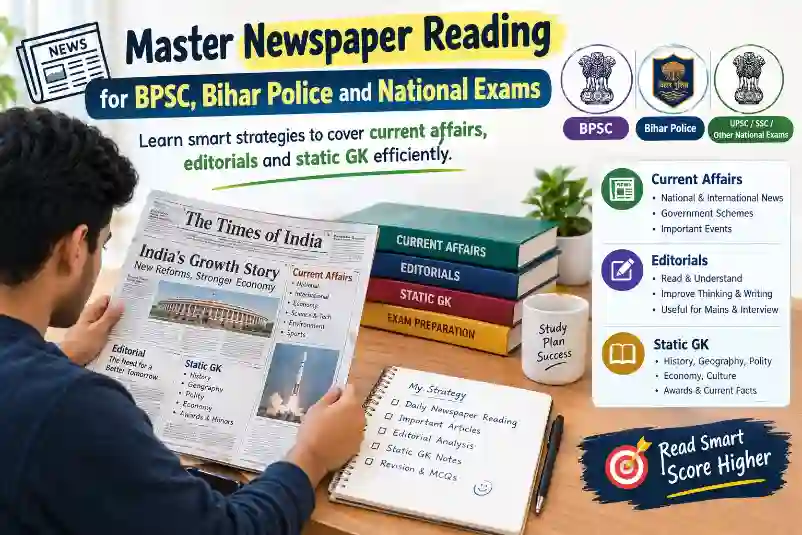
How to Read Newspapers Effectively for Bihar & National Current Affairs
Mastering current affairs is the ultimate cornerstone of cracking competitive examinations such as the Bihar Public Service Commission (BPSC), Bihar Police recruitment drives, and central tests conducted by the UPSC and Staff Selection Commission (SSC). Newspapers like The Hindu or The Indian Express for national updates, alongside prominent regional dailies for state-specific coverage, serve as the ultimate goldmine of information. However, aspirants often make the critical mistake of spending three to four hours daily reading every single page from cover to cover, leading to information overload and severe burnout. To clear government exams, you do not need to read like a novelist; you need to read like an investigator who knows exactly what the examination syllabus demands. This comprehensive, step-by-step guide outlines a smart, time-efficient framework to filter out the noise, extract high-yield national and Bihar-specific current affairs, maintain crisp revision notes, and structure your daily preparation for ultimate success.
Step 1: Syllabus Mapping and Master Filtering
The first and most vital step toward effective newspaper analysis is strict syllabus mapping and selective reading. Before opening a physical newspaper or browsing a digital e-paper, keep the official notification and syllabus of your target exam—such as BPSC Prelims, Mains General Studies papers, or SSC CGL syllabus—right on your desk.
- Focus on High-Yield Areas: Prioritize editorials, national policy shifts, economic developments, science and technology breakthroughs, environmental accords, and landmark Supreme Court judgments. These form the bedrock of descriptive mains answers and objective prelims questions.
- What to Strictly Skip: Avoid spending time on sensational local crime reports, political party gossip, page-three entertainment columns, sports opinion pieces (unless it concerns major international tournaments like Olympics or World Cups), and commercial advertisements.
- Time Management: Filtering your reading based strictly on exam relevance reduces your daily reading time to under 90 minutes while maximizing your conceptual clarity and mental bandwidth.
Step 2: Topic-Wise Segregation for National & International News
When reading national news, you must categorize information dynamically to match the GS paper structure of competitive exams. Breaking down news by topics ensures your brain registers facts in an organized, retrievable manner:
- Polity & Governance: Look for constitutional amendments, ordinances, central-state disputes, parliamentary bills, electoral reforms, and reports by constitutional bodies like the CAG or Election Commission.
- Economy & Agriculture: Track RBI monetary policies, inflation figures, fiscal deficit trends, budgetary announcements, MSP updates, agricultural export-import policies, and international trade agreements.
- Environment & Ecology: Pay close attention to climate change summits (COP meetings), wildlife conservation projects (like Project Tiger or Elephant), newly declared Ramsar sites, national parks, and pollution control regulations.
- Science & Technology: Note ISRO space missions, defense technology developments by DRDO, biotechnology advancements, artificial intelligence policies, and major public health initiatives.
- International Relations: Monitor India's bilateral ties with neighboring countries, strategic groupings (like Quad, BRICS, G20), geopolitical conflicts, and international organization reports (IMF, World Bank, UN).
Step 3: Tracking Bihar-Specific Current Affairs Separately
For aspirants targeting state-level examinations like BPSC, Bihar Police, BSSC, and regional civil services, national newspapers alone are entirely insufficient. State-specific questions carry massive weightage in prelims and mains exams.
- State Policy & Welfare Schemes: Actively track welfare programs launched by the Government of Bihar, such as student credit card schemes, rural livelihood missions, women empowerment initiatives, and health infrastructure upgrades.
- Budget & Economic Survey: Deeply analyze the Bihar State Budget and Economic Survey documents. Note allocations for education, energy, road construction, industrial development, and rural growth.
- Geographical & Cultural Highlights: Keep track of regional infrastructure projects (like bridge constructions over the Ganga, river-linking projects), GI-tagged products from Bihar (such as Magahi Paan, Shahi Litchi, Makhana), and historical or archaeological discoveries within the state.
- Dedicated Regional Notebook: Maintain a separate digital folder or physical notebook exclusively for Bihar current affairs so you can seamlessly integrate regional data with your static state history and geography preparation.
Step 4: The Art of Smart Note-Making & Static Linkage
Reading the newspaper without making notes is like writing in the sand. However, copying entire paragraphs verbatim is a waste of time. You must learn the art of crisp, micro-notes.
- The Bullet-Point Rule: Distill complex news items into 3 to 5 short bullet points covering the Core Issue, Key Stakeholders, Recent Data/Facts, and Significance or Way Forward.
- Static-Dynamic Linkage: Always connect current news items with your static books. For instance, if you read about an ordinance passed by the Governor, immediately revise Article 213 of the Indian Constitution from your standard polity textbook. If you read about a wildlife sanctuary in news, map its location in your static atlas.
- Digital vs. Physical Notes: Choose a method that suits your workflow. Many aspirants prefer cloud-based apps for easy searching, while others prefer handwritten notebooks to improve retention during writing.
Step 5: Revision Strategy and Utilizing Mock Tests
Even the best notes are useless without systematic, timely revision. Current affairs fade rapidly from memory if they are not reinforced.
- Weekly and Monthly Consolidation: Dedicate two hours every Sunday to review all your weekly notes. Once a month, consolidate them with monthly compilations.
- Testing Your Knowledge: Complement your newspaper reading with structured daily quizzes, sectional tests, and mock examinations. You can consistently check your preparation milestones and bridge any information gaps using resources and daily quizzes available on platforms like JobBodh.
- Consistency Wins: Consistency is your greatest asset in competitive exams. Reading selectively for 60 to 90 minutes every single day beats cramming bulky annual digests at the eleventh hour every single time. Stay disciplined, trust your roadmap, and turn current affairs from a weakness into your highest-scoring section!