
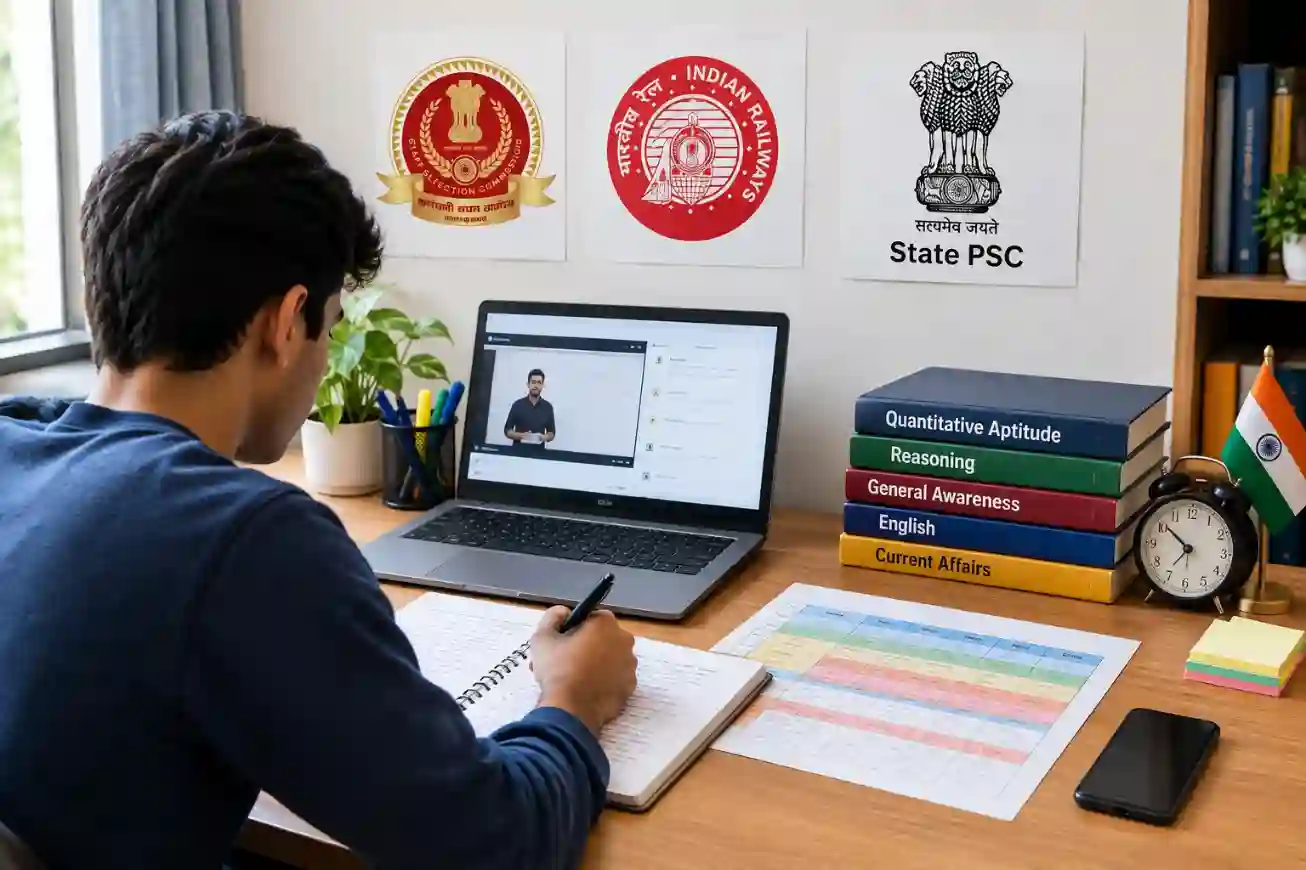
How to Prepare for Government Exams Without Coaching: Complete Self-Study Strategy
Many competitive exam aspirants believe that joining an expensive coaching institute is the only way to crack government exams like SSC, RRB, Banking, or State PSCs. However, thousands of successful candidates prove every year that self-study with the right discipline and strategy is more than enough to clear these high-stakes tests.
This comprehensive guide breaks down how you can structure your self-study routine, choose the right free resources, and maintain consistency to clear your target exam without attending coaching classes
Why Self-Study Can Be More Effective Than Coaching
- Flexible Pace: You can spend more time on weak topics and skip areas you have already mastered.
- Cost-Effective: Saves thousands of rupees on tuition fees, commute time, and accommodation expenses.
- Better Retention: Self-analyzing concepts and solving problems independently builds deeper conceptual clarity.
- Tailored Schedule: Allows you to design a personal timetable based on your daily productivity peak hours.
Step-by-Step Self-Study Roadmap
1. Analyze the Official Syllabus & Pattern
Before opening any textbook, download the official syllabus and notification for your targeted exam (e.g., SSC CGL, RRB NTPC, or Bihar Police Daroga). Categorize topics into three zones:
- Strong Areas: Topics you need minimal revision for.
- Moderate Areas: Topics requiring practice and formula memorization.
- Weak Areas: Topics that need step-by-step conceptual learning from scratch.
2. Select Standard & Minimal Reference Material
Avoid collecting too many books for a single subject. Stick to standard foundational resources:
- Quantitative Aptitude: Basic NCERTs (Class 6–10) or standard reference guides for tricks and shortcuts.
- General Awareness: Daily current affairs updates and NCERT History/Geography/Science summaries.
- Reasoning: Concept-wise practice sets focusing on analytical and verbal logic.
- English Language: Daily newspaper reading for vocabulary and grammar rules.
3. Build a Realistic Daily Timetable
| Time Slot | Activity / Subject | Focus Area |
|---|---|---|
| Morning (2 Hours) | Quantitative Aptitude / Mathematics | Concept building & problem-solving |
| Mid-Day (2 Hours) | General Awareness & Current Affairs | Reading daily updates & static GK |
| Afternoon (1.5 Hours) | Reasoning & Mental Ability | Topic-wise speed tests |
| Evening (1.5 Hours) | English / Language Section | Grammar rules & vocabulary revision |
| Night (1 Hour) | Mock Tests & Quiz Practice | Time management & error analysis |
The Role of Online Quizzes & Mock Tests
Without a coaching instructor to track your progress, online quizzes and mock tests act as your real-time performance indicator.
- Take at least 1 full-length mock test weekly during the early preparation phase.
- Increase frequency to daily mock tests during the final 30 days before the exam.
- Analyze mistakes: Keep an error notebook to record wrong answers and unattempted questions after every test.
Important Links
| Resource / Link Title | Action Link |
| Free Online Quizzes | Click Here |