
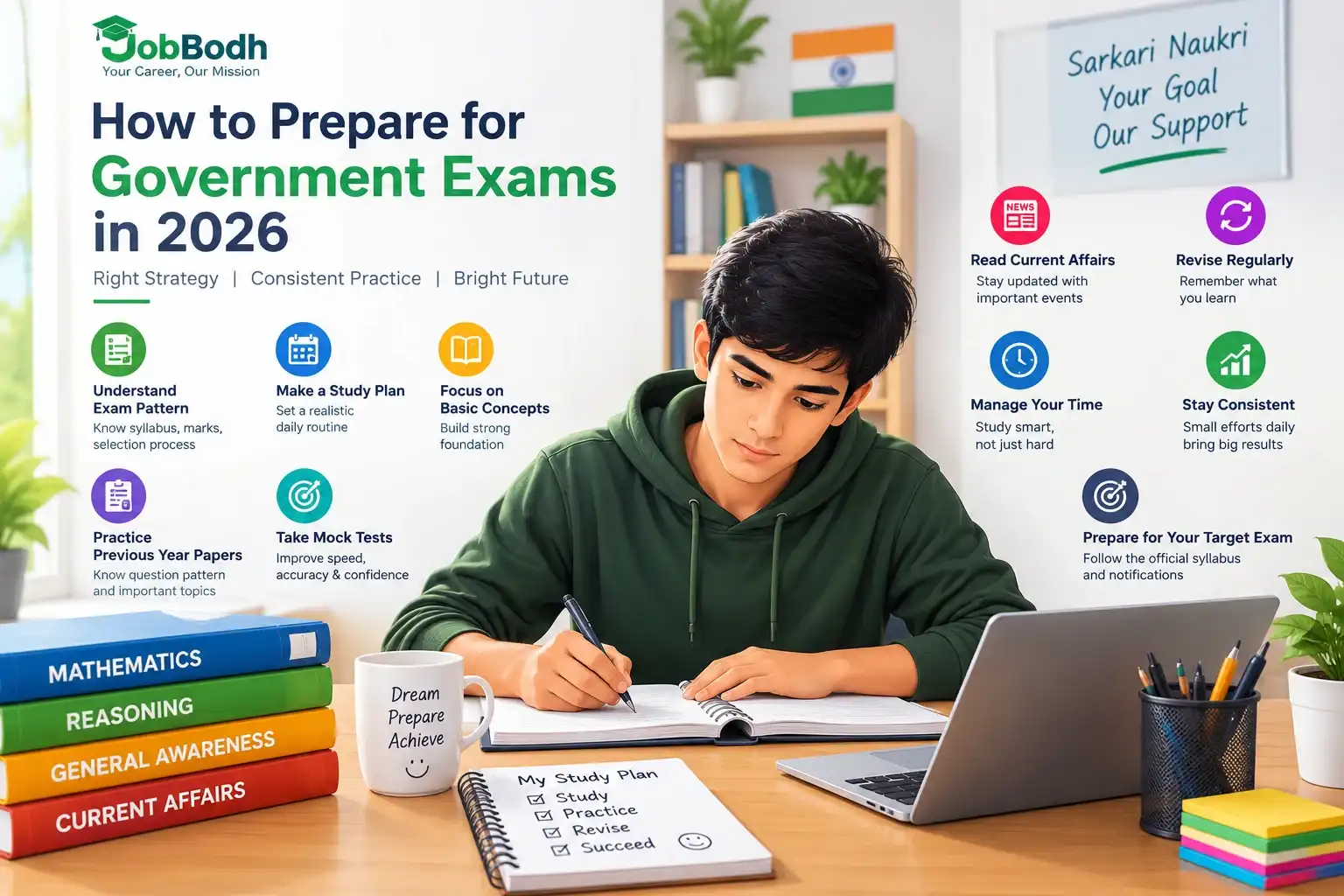
Master the Game: How to Crack Government Exams in 2026
Preparing for a government exam in 2026 demands more than just long study hours; it requires a modern, outcome-focused strategy. With lakhs of aspirants competing for limited vacancies across SSC, Banking, Railways, UPSC, and state-level commissions, traditional rote learning is no longer enough. The shift toward Computer-Based Tests (CBT), dynamically changing exam patterns, and evolving syllabus standards mean that smart preparation is now the key to success.
If you are aiming to secure a prestigious government job this year, this comprehensive guide will walk you through a practical, step-by-step framework to master the competition.
Step 1: Decode the Exam Pattern & Syllabus
- Before opening any textbook, your very first step is to understand the battlefield. Without absolute clarity on what you are studying for, even hard work can lead to burnout.
- Analyze Official Notifications: Download the latest official recruitment notification for your target exam and read through every single page carefully.
- Break Down Core Sections: Identify the core sections asked in the exam, such as Quantitative Aptitude, General Intelligence & Reasoning, English/Hindi Language, General Awareness, and Computer Literacy.
- Understand Marking Schemes: Pay close attention to negative marking rules, sectional weightage, and time limits. Knowing whether a wrong answer costs 0.25, 0.33, or 0.5 marks dictates your question-attempt strategy.
Step 2: Build a Structured 90-Day Roadmap
Consistency without direction leads nowhere. Divide your preparation journey into three progressive phases to ensure holistic coverage:
| Phase | Core Objective | Primary Action Items |
|---|---|---|
| Phase 1: Foundation | Concept clarity | Dedicate 60% of time to your weakest subject. Make short, structured notes using flowcharts. |
| Phase 2: Practice | Pattern recognition | Solve Previous Year Questions (PYQs) topic-wise. Do not wait to “finish” the syllabus before attempting PYQs. |
| Phase 3: Mocks | Speed & accuracy | Take 1 to 2 full-length online mock tests per week under strict timed conditions. Maintain an error log for missed concepts. |
Step 3: Master High-Yield Subjects
Every exam has high-scoring sections that can drastically improve your overall rank if handled systematically.
- Quantitative Aptitude & Reasoning: Instead of solving questions using long traditional formulas, learn shortcut techniques, Vedic math, and daily mental math tricks to drastically reduce calculation time.
- General Awareness (GA): Split GA into Static GK and Current Affairs. Limit your study material to one reliable daily source and monthly compilation to avoid information overload.
- Computer & Skill Tests: Practice basic typing, data entry, and digital literacy early. Qualifying tiers featuring computer proficiency tests are now standard across major banking and central exams.
Step 4: Execute Strategy Over Cramming
Smart candidates prioritize quality retention over piling up heavy study material.
- Spend at least 15 minutes every evening reviewing your error log to ensure you do not repeat the same mistakes.
- Protect your sleep schedule; sleep deprivation destroys cognitive speed and memory consolidation.
- Prioritize thorough, multiple revisions of standard books rather than buying multiple new reference books every week.
Step 5: Leverage Technology & AI Tools
In 2026, technology is your greatest equalizer. Make the most of digital learning aids to fast-track your progress:
- AI Study Assistants: Use AI tools to break down complex topics into quick summaries, generate custom quiz questions on tricky concepts, or explain difficult theorems.
- Spaced Repetition Apps: Use digital flashcard applications (like Anki) to optimize active recall for high-yield static GK, polity articles, and vocabulary.
- Peer Communities: Join active online discussion forums or Telegram groups strictly meant for daily quizzes, exam notifications, and discussions on changing syllabus trends.
Step 6: Track Mental & Physical Stamina
Clearing competitive exams is as much a mental battle as an academic one.
- Maintain a dedicated performance dashboard (using Notion, Excel, or a physical notebook) to track mock test scores, attempt speed, and subject-wise accuracy over time.
- Prevent burnout by working in Pomodoro focus blocks (e.g., 50 minutes of intense study followed by a strict 10-minute break).
- Ensure at least 7 hours of uninterrupted sleep on the nights leading up to mock tests to simulate actual exam-day mental sharpness.
Step 7: Build an Exam-Day Strategy
Your performance on the actual exam day depends heavily on your tactical execution inside the exam hall.
- Sectional Attempt Order: Tackle your strongest and fastest section first (such as General Awareness or English) to build early confidence and lock in quick marks.
- The Art of Skipping: If a question takes longer than 60 seconds without a clear path to the answer, mark it for review or skip it immediately to avoid time traps.
- Interface Familiarity: Double-check response guidelines for computer-based tests, including how negative marking is calculated, how to flag questions, and how section switches operate