
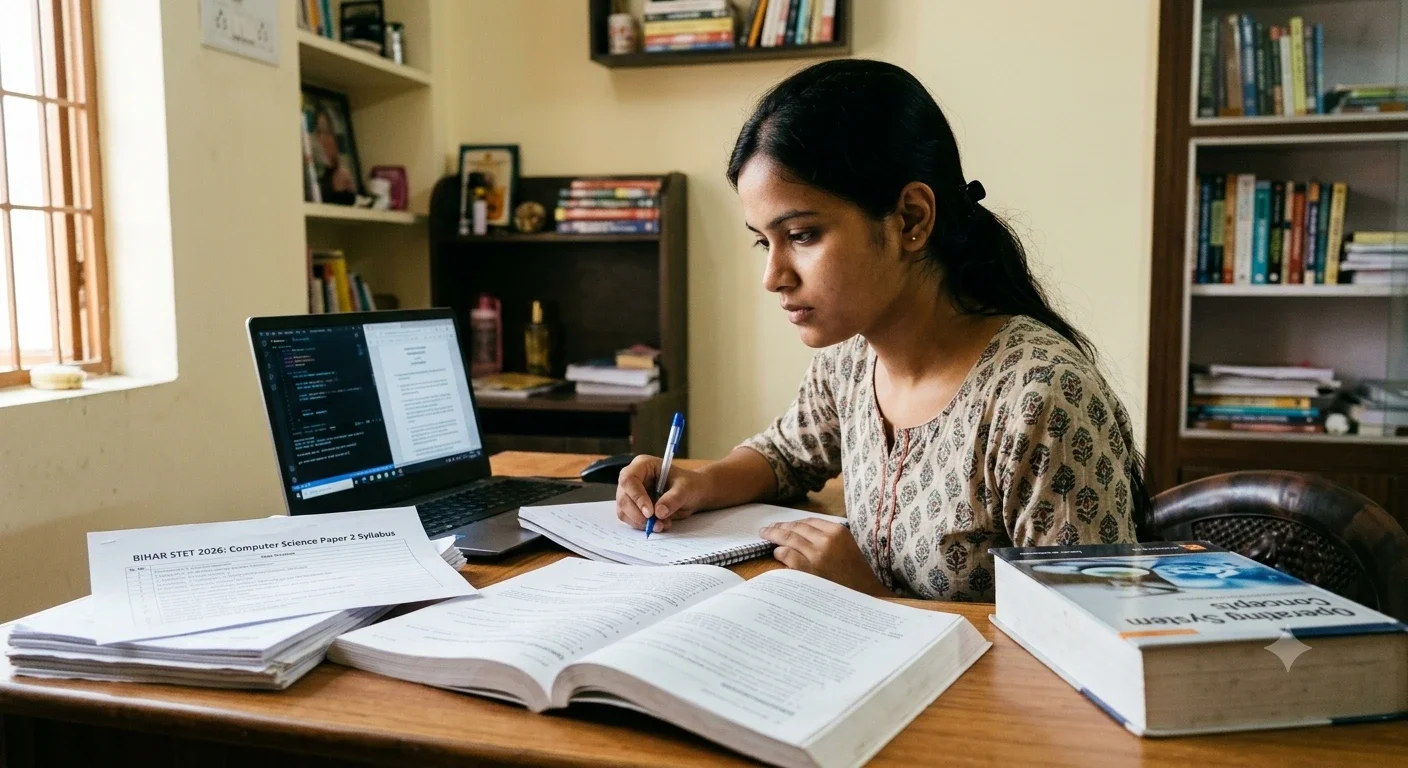
Bihar STET Computer Science (Paper 2) 2026: Exam Overview & Syllabus Analysis
Clearing the Bihar State Teachers Eligibility Test (Bihar STET Paper 2) for Computer Science requires a disciplined strategy, conceptual depth, and precise syllabus clarity. With a total of 150 objective questions testing both technical mastery and pedagogical teaching skills, cracking this examination is the mandatory gateway for aspirants wishing to become high school computer science teachers across schools in Bihar.
Managed by the Bihar School Examination Board (BSEB), the exam allocates 100 questions strictly to core Computer Science domains and 50 questions to the Art of Teaching and general mental abilities. This comprehensive guide breaks down the detailed unit-wise syllabus, exam structure, marking scheme, qualifying criteria, and actionable preparation tips to help you secure a top rank.
Bihar STET Computer Science (Paper 2) Exam Pattern 2026
The Bihar STET Computer Science examination is conducted in a single phase via a Computer-Based Test (CBT). Understanding the structural distribution of questions and marks is essential for mapping out your daily study routine.
| Section | Subject / Domain | Questions | Marks |
| Specified Subject | Computer Science | 100 | 100 |
| Teaching Art & Skills | Art of Teaching & General Knowledge | 50 | 50 |
| Total | 150 | 150 |
- Question Type: Multiple Choice Questions (MCQs) with four options.
- Exam Mode: Computer-Based Test (CBT).
- Negative Marking: There is no negative marking scheme in Bihar STET, allowing candidates to attempt all questions strategically.
Detailed Unit-Wise Computer Science Syllabus (100 Marks)
To secure a high score in the core technical section, candidates must master the fundamental and advanced concepts across the following seven key units:
1. Database Management Systems (DBMS)
- Entity-Relationship (ER) Models and conceptual database design.
- Relational Algebra, Relational Calculus, and Structured Query Language (SQL Queries).
- Database Normalization: First Normal Form (1NF), Second Normal Form (2NF), Third Normal Form (3NF), and Boyce-Codd Normal Form (BCNF).
- Transaction Processing, ACID properties, and Concurrency Control protocols.
2. Operating Systems (OS)
- Process Management, Threads, and Process Synchronization.
- CPU Scheduling Algorithms: First-Come, First-Served (FCFS), Shortest Job First (SJF), Priority Scheduling, and Round Robin.
- Deadlock Characterization, Prevention, Avoidance, and Detection.
- Memory Management: Paging, Segmentation, Virtual Memory, and Page Replacement Algorithms.
- Basic Linux/Unix Shell Commands and file system structures.
3. Computer Networks
- Reference Models: OSI 7-Layer Model and TCP/IP Reference Model.
- IP Addressing: IPv4 and IPv6 addressing classes, subnetting, and network masking.
- Routing Protocols (Distance Vector and Link State routing).
- Transport Layer Protocols: Transmission Control Protocol (TCP) and User Datagram Protocol (UDP).
- Fundamentals of Network Security: Firewalls, encryption basics, and cryptography fundamentals.
4. Data Structures & Algorithms (DSA)
- Linear Data Structures: Arrays, Stacks, Queues, and Linked Lists (Singly, Doubly, and Circular).
- Non-Linear Data Structures: Trees (Binary Trees, BST, AVL Trees) and Graphs (BFS, DFS traversal).
- Sorting Algorithms: Bubble sort, Selection sort, Insertion sort, Merge sort, and Quick sort.
- Searching Algorithms: Linear search and Binary search.
- Asymptotic Notation and Time/Space Complexity Analysis.
5. Programming & Object-Oriented Concepts (OOPs)
- Core programming fundamentals using C++, Java, and Python.
- Principles of Object-Oriented Programming: Classes, Objects, Inheritance, Polymorphism, Encapsulation, and Abstraction.
- Exception Handling, constructors, destructors, and file handling operations.
6. Software Engineering
- Software Development Life Cycle (SDLC) models: Waterfall, Agile, Spiral, and Prototyping.
- Requirement Engineering, Analysis, and Specification.
- Software Testing Strategies: Unit testing, integration testing, system testing, and white-box/black-box testing.
- Project management basics and software quality assurance.
7. Computer Organization & Architecture
- Boolean Algebra, Karnaugh Maps (K-Maps), and Logic Gates.
- Instruction Formats, addressing modes, and CPU architecture.
- Memory Hierarchy: Cache memory, primary memory, and secondary storage devices.
- Pipeline Architecture and instruction-level parallelism.
Art of Teaching & General Skills Syllabus (50 Marks)
The second part of the paper evaluates your teaching aptitude and general mental alertness, which acts as a crucial rank booster.
- Art of Teaching (30 Marks): Teaching Objectives and goals, Methods and strategies of teaching, Lesson Planning, Micro-Teaching techniques, Classroom Management, Evaluation and Continuous Comprehensive Assessment systems, and Ideal Teacher Characteristics.
- General Knowledge & Logical Reasoning (20 Marks): General awareness of Bihar state, current national/international affairs, logical reasoning puzzles, quantitative mathematical aptitude, and basic environmental science.
Expert Preparation Tips to Crack Bihar STET 2026
- Master Core Concepts First: Focus heavily on high-weightage topics like DBMS, Networking, and Operating Systems. Practice conceptual MCQs daily.
- Solve Chapter-Wise Quizzes: Regular assessment through targeted quizzes helps identify weak areas before the final CBT exam.
- Focus on Pedagogy: Do not ignore the 30 marks dedicated to the Art of Teaching; scoring well here acts as a rank booster.
- Time Management: Since there is no negative marking, attempt all 150 questions strategically within the allotted time frame.
Negative Marking: No negative marking scheme
| Qualifying Criteria | Cut-off Marks |
| General Unreserved | 50% (75 / 150 Marks) |
| BC (Backward Class) | 45.5% (68.25 / 150 Marks) |
| EBC (Extremely Backward Class) | 42.5% (63.75 / 150 Marks) |
| SC / ST / PwD / Women | 40% (60 / 150 Marks) |
| Resource | Direct Links |
| Apply Online Direct Link | Click Here |
| Official BSEB Portal | Click Here |
| Download Bihar STET Computer Science Syllabus PDF | Click Here |
| Bihar STET Computer Science DBMS Notes 2026 | Click Here |
| Bihar STET Computer Science Computer Network Notes 2026 | Click Here |
| Bihar STET Computer Science Operating System Notes 2026 | Click Here |
| Bihar STET Computer Science Multimedia Notes 2026 | Click Here |
| Bihar STET Computer Science Quiz | Click Here |